


How do crystal glass large plate achieve high refractive index and brilliant luster?
Release Time : 2026-01-15
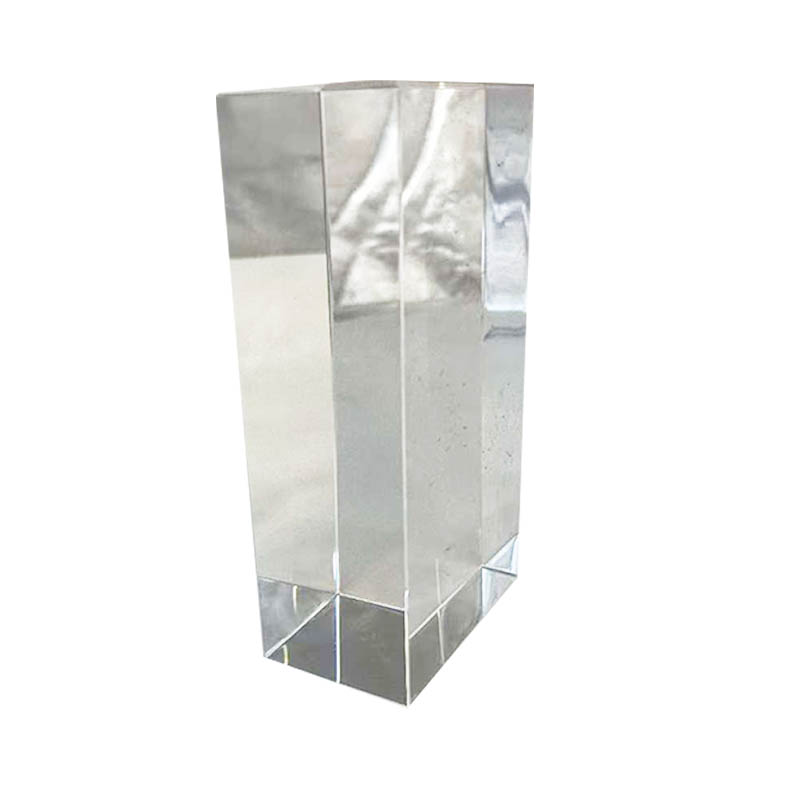
In the field of modern decorative materials and high-end crafts, crystal glass large plate are highly favored for their crystal-clear and dazzling visual effect. Although not natural crystal, it can exhibit a sparkling luster similar to diamonds or high-grade crystals under light, and is widely used in lighting fixtures, furniture panels, building curtain walls, display props, and even art installations.
1. High Refractive Index: Derived from a Special Glass Formula
The refractive index is the core physical parameter that determines whether a material is "sparkling." Some high-end products even exceed 1.70, approaching the level of lead crystal glass. This high refractive index is mainly achieved by introducing high-density metal oxides into the base glass melt. This significantly increases the electronic polarizability of the glass, thereby enhancing its ability to bend incident light. Among them, lead oxide is the most classic refractive index enhancer. It not only increases the refractive index but also lowers the melting temperature of the glass, improves processing performance, and gives the finished product a better dispersion effect—that is, "fire," decomposing white light into a seven-color spectrum. However, for environmental and health reasons, modern imitation crystal glass increasingly adopts lead-free formulas, instead using composite oxide systems of elements such as barium, zinc, and titanium, maintaining a high refractive index while meeting environmental standards such as RoHS.
2. Brilliant Luster: Relying on Precision Surface Processing and Optical Design
High refractive index alone is insufficient to produce dazzling brilliance; a brilliant effect also relies on meticulous surface treatment. Crystal glass large plate typically undergo multiple fine polishing processes to control their surface roughness at the nanometer level, thereby minimizing light scattering and achieving a mirror-like transparency. Building upon this, manufacturers often combine the following processes to further enhance optical performance:
Precision Cutting and Faceting: Borrowing from crystal cutting techniques, multi-angled bevels are processed on the edges or specific areas of the glass plate, forming multiple reflective and refractive surfaces. When light is incident, it is repeatedly refracted, totally reflected, and dispersed on these tiny planes, producing a shimmering, vibrant "fire."
Coating Technology: Some high-end products deposit one or more layers of optical thin films on the surface, utilizing the principle of interference to enhance the reflection of specific wavelengths, creating iridescent or metallic luster effects.
Internal Texture and Layered Design: By embossing, etching, or embedding microstructured thin films, light paths can be guided to create dynamic light and shadow variations without compromising overall transparency.
3. Overall Texture: The Synergistic Effect of Transparency, Uniformity, and Thickness
Besides refraction and surface treatment, the overall visual impact of a crystal glass large plate also depends on its intrinsic quality. High-purity raw materials ensure extremely low impurity content, avoiding bubbles, streaks, or yellowing; homogeneous melting processes ensure consistent component distribution, preventing optical distortion; and a reasonable thickness design balances weight, strength, and optical path length—a sufficiently thick plate allows light to undergo more internal reflections, amplifying the brilliance without appearing bulky.
The brilliance of a crystal glass large plate is not accidental, but the result of the combined efforts of materials chemistry, optical physics, and precision manufacturing. It achieves this by scientifically adjusting the glass composition to increase the refractive index, using advanced processing techniques to sculpt the light path, and ensuring overall transparency and uniformity through rigorous quality control. This is why this "artificial crystal" can retain the practicality of glass while replicating the magnificent beauty of natural crystal, making it an ideal material in modern design that combines aesthetic value with engineering feasibility. In the future, with the integration of new technologies such as nanostructures and intelligent dimming, crystal glass large plates may unleash even more stunning optical charm.
1. High Refractive Index: Derived from a Special Glass Formula
The refractive index is the core physical parameter that determines whether a material is "sparkling." Some high-end products even exceed 1.70, approaching the level of lead crystal glass. This high refractive index is mainly achieved by introducing high-density metal oxides into the base glass melt. This significantly increases the electronic polarizability of the glass, thereby enhancing its ability to bend incident light. Among them, lead oxide is the most classic refractive index enhancer. It not only increases the refractive index but also lowers the melting temperature of the glass, improves processing performance, and gives the finished product a better dispersion effect—that is, "fire," decomposing white light into a seven-color spectrum. However, for environmental and health reasons, modern imitation crystal glass increasingly adopts lead-free formulas, instead using composite oxide systems of elements such as barium, zinc, and titanium, maintaining a high refractive index while meeting environmental standards such as RoHS.
2. Brilliant Luster: Relying on Precision Surface Processing and Optical Design
High refractive index alone is insufficient to produce dazzling brilliance; a brilliant effect also relies on meticulous surface treatment. Crystal glass large plate typically undergo multiple fine polishing processes to control their surface roughness at the nanometer level, thereby minimizing light scattering and achieving a mirror-like transparency. Building upon this, manufacturers often combine the following processes to further enhance optical performance:
Precision Cutting and Faceting: Borrowing from crystal cutting techniques, multi-angled bevels are processed on the edges or specific areas of the glass plate, forming multiple reflective and refractive surfaces. When light is incident, it is repeatedly refracted, totally reflected, and dispersed on these tiny planes, producing a shimmering, vibrant "fire."
Coating Technology: Some high-end products deposit one or more layers of optical thin films on the surface, utilizing the principle of interference to enhance the reflection of specific wavelengths, creating iridescent or metallic luster effects.
Internal Texture and Layered Design: By embossing, etching, or embedding microstructured thin films, light paths can be guided to create dynamic light and shadow variations without compromising overall transparency.
3. Overall Texture: The Synergistic Effect of Transparency, Uniformity, and Thickness
Besides refraction and surface treatment, the overall visual impact of a crystal glass large plate also depends on its intrinsic quality. High-purity raw materials ensure extremely low impurity content, avoiding bubbles, streaks, or yellowing; homogeneous melting processes ensure consistent component distribution, preventing optical distortion; and a reasonable thickness design balances weight, strength, and optical path length—a sufficiently thick plate allows light to undergo more internal reflections, amplifying the brilliance without appearing bulky.
The brilliance of a crystal glass large plate is not accidental, but the result of the combined efforts of materials chemistry, optical physics, and precision manufacturing. It achieves this by scientifically adjusting the glass composition to increase the refractive index, using advanced processing techniques to sculpt the light path, and ensuring overall transparency and uniformity through rigorous quality control. This is why this "artificial crystal" can retain the practicality of glass while replicating the magnificent beauty of natural crystal, making it an ideal material in modern design that combines aesthetic value with engineering feasibility. In the future, with the integration of new technologies such as nanostructures and intelligent dimming, crystal glass large plates may unleash even more stunning optical charm.