


Can glass balls, with their pure materials and precise composition, become the invisible source of high-efficiency air filtration?
Release Time : 2026-01-30
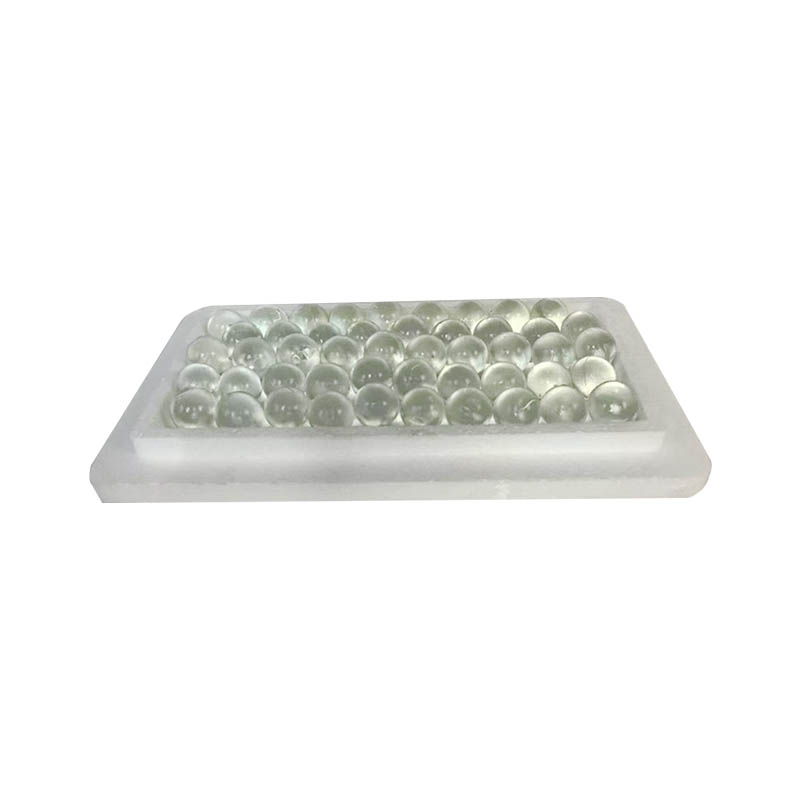
In modern industrial and health protection systems, air cleanliness is no longer just a matter of comfort; it is directly related to production yield, equipment lifespan, and even human respiratory safety. Behind this invisible battle for purification lies a seemingly ordinary yet crucial basic material—specialized glass balls used to produce air filter paper. These are not decorative items or containers, but tiny spheres made from high-purity glass melt with a specific chemical composition. As the core raw material for manufacturing glass microfibers, after being melted and drawn at high temperatures, they transform into countless ultra-fine fibers, weaving the framework of high-efficiency filter media. These tiny glass balls, though unseen by end-users, are the source of performance assurance for high-end air filter materials.
Their core value lies first and foremost in the extreme requirements for the purity and stability of raw materials. Specialized glass balls are typically carefully formulated with high-silicon, low-alkali, or alkali-free formulas, strictly controlling the content of impurities such as iron, sodium, and calcium to ensure that the molten glass has ideal viscosity, surface tension, and thermal stability. Only in this way can they be uniformly stretched into continuous microfibers with a diameter of only a few micrometers during high-speed centrifugation or flame blowing processes. These fibers intertwine into a network with fine and uniformly distributed pores, achieving both high efficiency in intercepting micron-sized particles and low airflow resistance, thus realizing an ideal balance of "high dust holding capacity and low air resistance."
In the production process, the uniformity of the glass balls directly determines the consistency of the filter material's quality. Each ball must be of regular size, free of bubbles, stones, and cracks, ensuring uniform heating and complete melting in the furnace. Any minute deviation in composition or physical defects can lead to uneven fiber thickness and increased filament breakage, thereby affecting the filter paper's strength, permeability, and filtration efficiency. Therefore, from raw material selection and proportioning calculation to melting and cooling, the entire process must be completed in a highly clean and precisely temperature-controlled environment, reflecting a deep integration of materials science and manufacturing processes.
A deeper significance lies in the fact that the end-use applications it supports are related to significant public and industrial needs. Filter paper made from glass microfibers is widely used in high-efficiency/ultra-high-efficiency air filters (HEPA/ULPA), serving hospital operating rooms, biological laboratories, semiconductor cleanrooms, nuclear power plant ventilation systems, and high-end home air purification equipment. In these scenarios, the efficiency of trapping 0.3-micron particles can determine the success or failure of experiments, chip yield, and even patient safety. And all of this begins with those crystal-clear special glass balls—silently pure, they form the first line of defense against pollution.
Furthermore, sustainability is integrated into its lifecycle. High-quality glass balls can be partially made from recycled glass raw materials, melted in a closed-loop system, reducing resource consumption; its final product—glass fiber filter media—is non-flammable, chemically inert, and has a long service life, and can be regenerated at high temperatures after disposal, reducing the environmental burden. This green approach from source to end ensures that high-performance filtration does not come at the expense of the environment.
Ultimately, the value of a special glass ball lies not in its aesthetic appeal, but in how it undergoes a transformation at high temperatures, becoming an invisible net protecting our breath. When clean air flows silently through the laboratory, when the operating room maintains a sterile environment—behind it all lies this tiny sphere, with its extremely pure and stable composition, silently supporting modern civilization's fundamental right to "clean air." Because in the logic of materials science, true power is not in the grand and visible, but in weaving the most trustworthy barrier from the purest starting point—transparent as water, indestructible.
Their core value lies first and foremost in the extreme requirements for the purity and stability of raw materials. Specialized glass balls are typically carefully formulated with high-silicon, low-alkali, or alkali-free formulas, strictly controlling the content of impurities such as iron, sodium, and calcium to ensure that the molten glass has ideal viscosity, surface tension, and thermal stability. Only in this way can they be uniformly stretched into continuous microfibers with a diameter of only a few micrometers during high-speed centrifugation or flame blowing processes. These fibers intertwine into a network with fine and uniformly distributed pores, achieving both high efficiency in intercepting micron-sized particles and low airflow resistance, thus realizing an ideal balance of "high dust holding capacity and low air resistance."
In the production process, the uniformity of the glass balls directly determines the consistency of the filter material's quality. Each ball must be of regular size, free of bubbles, stones, and cracks, ensuring uniform heating and complete melting in the furnace. Any minute deviation in composition or physical defects can lead to uneven fiber thickness and increased filament breakage, thereby affecting the filter paper's strength, permeability, and filtration efficiency. Therefore, from raw material selection and proportioning calculation to melting and cooling, the entire process must be completed in a highly clean and precisely temperature-controlled environment, reflecting a deep integration of materials science and manufacturing processes.
A deeper significance lies in the fact that the end-use applications it supports are related to significant public and industrial needs. Filter paper made from glass microfibers is widely used in high-efficiency/ultra-high-efficiency air filters (HEPA/ULPA), serving hospital operating rooms, biological laboratories, semiconductor cleanrooms, nuclear power plant ventilation systems, and high-end home air purification equipment. In these scenarios, the efficiency of trapping 0.3-micron particles can determine the success or failure of experiments, chip yield, and even patient safety. And all of this begins with those crystal-clear special glass balls—silently pure, they form the first line of defense against pollution.
Furthermore, sustainability is integrated into its lifecycle. High-quality glass balls can be partially made from recycled glass raw materials, melted in a closed-loop system, reducing resource consumption; its final product—glass fiber filter media—is non-flammable, chemically inert, and has a long service life, and can be regenerated at high temperatures after disposal, reducing the environmental burden. This green approach from source to end ensures that high-performance filtration does not come at the expense of the environment.
Ultimately, the value of a special glass ball lies not in its aesthetic appeal, but in how it undergoes a transformation at high temperatures, becoming an invisible net protecting our breath. When clean air flows silently through the laboratory, when the operating room maintains a sterile environment—behind it all lies this tiny sphere, with its extremely pure and stable composition, silently supporting modern civilization's fundamental right to "clean air." Because in the logic of materials science, true power is not in the grand and visible, but in weaving the most trustworthy barrier from the purest starting point—transparent as water, indestructible.